Armor Set
 面
面
 Kote
Kote
 胴
胴
 垂
垂
 Dogi
Dogi
 袴
袴
 bamboo sword
 wooden sword
 armor bag
 Bamboo sword bag
 Small items
 gift
gift
 Books/DVDs
 cleaning
 Armor repair
 Kendo mask
 Iaido
Iaido
 Japanese swords and art swords
 Mitsuboshi
 Tozando
 Matsukan
 Japan Kendo Equipment Factory
 West Japan Martial Arts Equipment
 Glory Martial Arts Equipment
 Nobutake
 Busougi
 Hakataya
 Shokodo
 Flag Ito
 メールお問い合わせ
 LINEお問い合わせ


 Value Set
 Armor Set
 面
面
 Kote
Kote
 胴
胴
 垂
垂
 Dogi
Dogi
 袴
袴
 bamboo sword
 wooden sword
 armor bag
 Bamboo sword bag
 Small items
 gift
gift
 Books/DVDs
 cleaning
 Armor repair
 Kendo mask
 Outlet
 Iaido
Iaido
 Japanese swords and art swords
 Mitsuboshi
 Tozando
 Matsukan
 Japan Kendo Equipment Factory
 West Japan Martial Arts Equipment
 Glory Martial Arts Equipment
 Nobutake
 Taiyo Industry
 Busougi
 Hakataya
 Shokodo
 Flag Ito
 Interviews Useful Articles
 Size Measurement Guide
 User Guide
 GLOBAL SHIPPING GUIDANCE
 Frequently Asked Questions Q&A
 Company Profile

profile
 Nishinippon Budogu Co., Ltd.
Representative Director Junji Nishi
Nishinippon Budogu Co., Ltd.
Representative Director Junji Nishi
Uncompromising passion for making bamboo swords
-When did your company start selling products as a shinai manufacturer? President : "I've been involved with bamboo swords for over 30 years. I started selling kendo equipment about 10 years ago." —Please tell us your thoughts as a manufacturer on making bamboo swords. President : "Most of the bamboo swords currently on the market are made from Taiwanese katana bamboo. There are also bamboo swords labeled as "madake," but we believe that it is not clear whether they are domestically produced madake or Chinese madake, which is an issue. Rather than judging it to be good or bad, I believe it is the role of a manufacturer to convey the facts properly, and that it is important. There are many excellent Chinese bamboo products with excellent finishes, and of course there are good things about Japanese bamboo. Our mission is to have as many kendo practitioners as possible know about and use our products, which we believe will help ensure that Japanese bamboo sword craftsmen continue to exist."Tour of the bamboo sword factory

Nakagawa Bamboo Factory, located deep in the mountains of Fukuoka
Sunagawa : "Both the Bungo wood for our brand 'Josui' and the Kyoto wood for 'Kokusho' are harvested and sent to us by artisans. By the way, only about 50-60% of the material is usable for making 39 shinai." -Surprisingly, the percentage of bamboo swords that can be used is small. Sunagawa : Yes, that's right. Every year, people from the public and martial arts equipment stores come to tour this factory from far away. When we explain the materials and manufacturing process, the specifications for weight and grip thickness at the time of ordering change from a certain number of grams and a certain number of millimeters in diameter to a certain number of grams and a certain number of millimeters in diameter. -So on the contrary, it ends up being a rough order! Why is that? Sunagawa : "I think it's because they understood the difficulties involved in the manufacturing process of bamboo swords and the passion of the craftsmen. Furthermore, although the swords are made by bamboo sword artisans, the craftsmen who cut down the bamboo also have a very hard time. We believe it is important for people to understand this current situation. I would like all kendo practitioners to come and see this factory, even if just once."
Huge amount of bamboo shavings
Do you think there is a shortage of craftsmen? Sunagawa : "That's true. There are only a handful of them in the whole country." -Will your craftsmen not be able to share and spread your manufacturing techniques overseas? Sunagawa : "The bamboo swords produced at the Madake factory are the color of Kyoto bamboo in Kyoto and Bungo bamboo in Bungo. Each craftsman has a different drying method. The way the bamboo is "heated" and bent differs, and the way it transmits when struck also differs. That's why it can only be made here." Managing Director Sunagawa
Inside the factory

Bamboo sword maker Shigemasa Ohashi
Sunagawa : About 10 years ago, our president had a desire to open a bamboo factory and nurture and preserve the craftsmen who make bamboo swords. Originally, Ohashi was making completely handmade bamboo swords called "Yamato," so we asked him to help us realize our "vision," and the bamboo factory was started. The result was the "Josui" shinai, made entirely from Japanese-made real bamboo."Baking process
Ohashi : "It's the process of hardening the bamboo to make it stronger. It's a basic step in shaping the shinai, but it's important."
Smoke is rising from the bamboo
—Do you mean this by pre-processing? Ohashi : "That's right. This is the process that craftsmen consider most important. If this process is not done properly, the process will not go well until the end. It takes about 10 to 15 minutes to straighten four pieces. We straighten four pieces at a time. We work on all four pieces at once until the very end. ...This is the bamboo oil."
Glossy bamboo
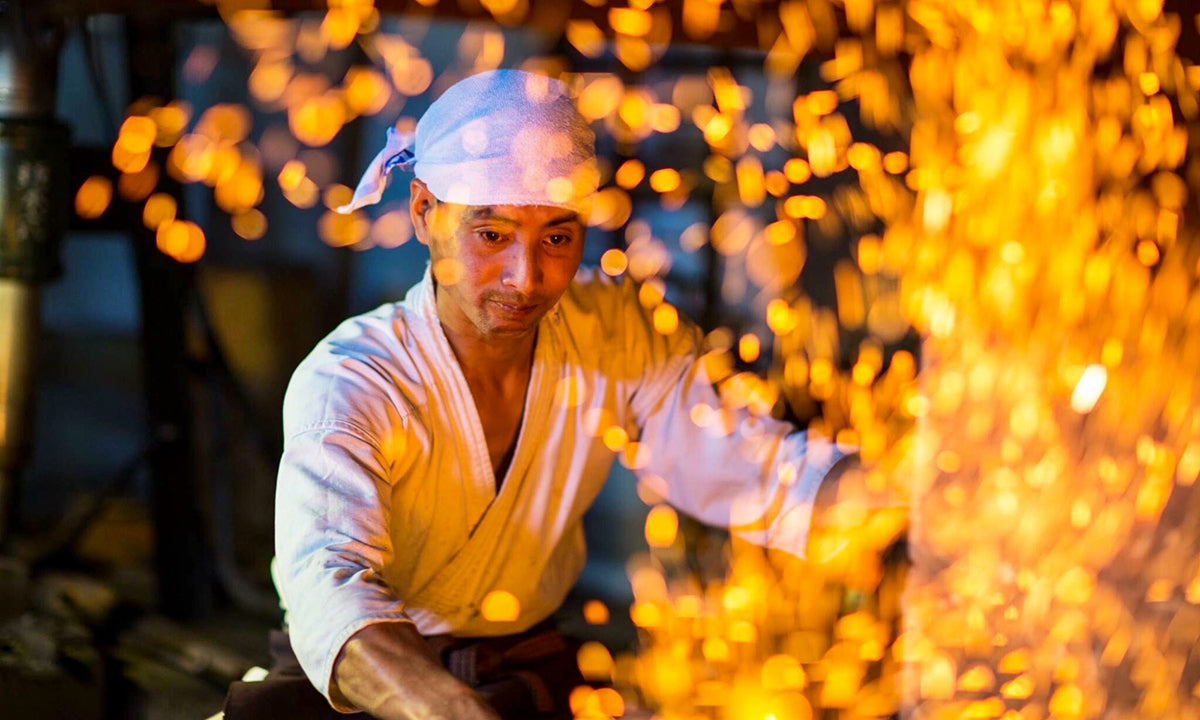
- Does it come out naturally? Ohashi : "That's right. In artisan jargon, this state is called 'the bamboo has boiled.' You can see steam coming out, right? Water is coming out of the fibers. We judge the bamboo's doneness by the amount of water released and the amount of oil released from the skin. We then stretch it and shape it. It's not good to overcook it, but it's also not good to undercook it."Training young craftsmen
-Why did you both decide to become bamboo sword craftsmen? Tamura : "I had never seen anyone make a bamboo sword before, and there weren't many places where I could do it, so I was simply interested in trying it. I used to do kendo, after all." Kusaka: "I was curious to try it myself, so I jumped in."
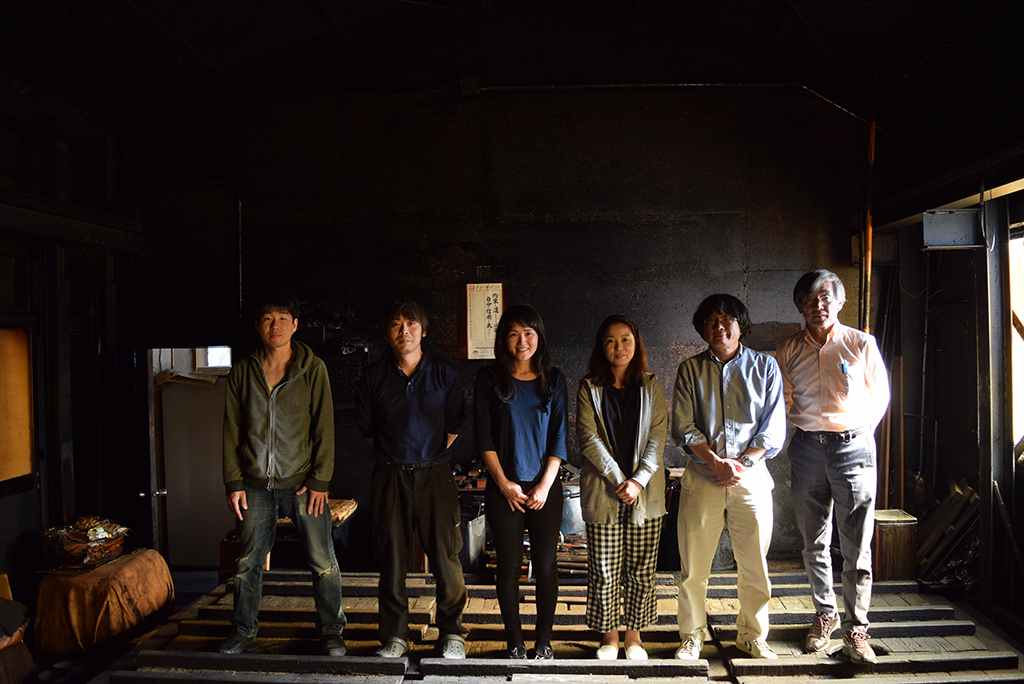
Mr. Ohashi's successors, Mr. Kazuki Kusaka (left) and Mr. Yuya Tamura (right)
—What do you find rewarding about your job? Kusaka : "When I first made one, I was so happy just being able to turn the bamboo into a shinai." Tamura : "It makes me happy when I get feedback from sales staff that the product is in good condition. I also like it when customers are happy." -I look forward to seeing you two nurturing the next generation someday. Thank you for today.
 Click here for the product page of Nishinippon Budougu, the company we interviewed this time!
interviewer
◎ Representative Director: Go Ueshima
Click here for the product page of Nishinippon Budougu, the company we interviewed this time!
interviewer
◎ Representative Director: Go Ueshima
 Born in Sendai in 1987. While in the Sendai High School Kendo Club, he studied under Mitsunobu Sato and made it to the top eight of the Inter-High School Championships.
After graduating from university, he worked as the business development manager for a restaurant chain with 200 stores across the U.S. He worked in sales at a foreign internet advertising company and as the head of the sales department and president's office at Innova Co., Ltd., before founding Bushizo Inc. in January 2017.
◎ Director Yusuke Kudo
Born in Sendai in 1987. While in the Sendai High School Kendo Club, he studied under Mitsunobu Sato and made it to the top eight of the Inter-High School Championships.
After graduating from university, he worked as the business development manager for a restaurant chain with 200 stores across the U.S. He worked in sales at a foreign internet advertising company and as the head of the sales department and president's office at Innova Co., Ltd., before founding Bushizo Inc. in January 2017.
◎ Director Yusuke Kudo
 Born in Hokkaido in 1984. Graduated from Rikkyo University's Faculty of Law. While in school, he launched a free magazine and provided marketing support for an apparel brand. In 2008, he joined Yahoo Japan Corporation, where he worked in sales of advertising products such as search advertising and display advertising. In January 2017, he founded Bushizo Inc. He began practicing kendo at the age of six and continues to practice it to this day.