Armor Set
 面
面
 Kote
Kote
 胴
胴
 垂
垂
 Dogi
Dogi
 袴
袴
 bamboo sword
 wooden sword
 armor bag
 Bamboo sword bag
 Small items
 gift
gift
 Books/DVDs
 cleaning
 Armor repair
 Kendo mask
 Iaido
Iaido
 Japanese swords and art swords
 Mitsuboshi
 Tozando
 Matsukan
 Japan Kendo Equipment Factory
 West Japan Martial Arts Equipment
 Glory Martial Arts Equipment
 Nobutake
 Busougi
 Hakataya
 Shokodo
 Flag Ito
 メールお問い合わせ
 LINEお問い合わせ


 Value Set
 Armor Set
 面
面
 Kote
Kote
 胴
胴
 垂
垂
 Dogi
Dogi
 袴
袴
 bamboo sword
 wooden sword
 armor bag
 Bamboo sword bag
 Small items
 gift
gift
 Books/DVDs
 cleaning
 Armor repair
 Kendo mask
 Outlet
 Iaido
Iaido
 Japanese swords and art swords
 Mitsuboshi
 Tozando
 Matsukan
 Japan Kendo Equipment Factory
 West Japan Martial Arts Equipment
 Glory Martial Arts Equipment
 Nobutake
 Taiyo Industry
 Busougi
 Hakataya
 Shokodo
 Flag Ito
 Interviews Useful Articles
 Size Measurement Guide
 User Guide
 GLOBAL SHIPPING GUIDANCE
 Frequently Asked Questions Q&A
 Company Profile

profile
Yoshiki Kumagai, Representative Director of ENN Co., Ltd.
Tomofumi Kumagai, Wardrobe Business Manager, ENN Co., Ltd.
Mr. Takamichi Kurosaki, craftsman, Wardrobe Division, ENN Co., Ltd.
President's biography
—Please tell us about your background as president . President Kumagai : "I joined a housing manufacturer as a new graduate, but only lasted a year. I was torn between wanting to work in the food service industry and the company I joined as a new graduate. After much deliberation, I quit the housing manufacturer and returned to my hometown of Sendai."
President Yoshiki Kumagai wearing an enn living works cap
—When did you start your business? President Kumagai : "I worked as an employee in restaurants for about eight years. I was made manager of the last restaurant I worked at. I quit at the age of 30 and went independent." -You currently run two restaurants. Why did you start up your wardrobe business (enn living works)? President Kumagai : "I was originally interested in providing food, clothing, and shelter. 'Food' comes from running a restaurant. I've always loved clothes, so I wanted to get into 'clothing' as well. 'Housing' doesn't mean I want to get into the real estate business, but rather small items and interior decor related to daily life. I thought that if we could provide food, clothing, and shelter as a company, that would be the strongest." —I imagine it as a company that improves quality of life. President Kumagai : "To put it in a cool way (laughs). My younger brother Tomofumi also agreed with me, so we decided to start with food and beverages, and then move on to clothing and housing." —Tomofumi, you also started out working in a restaurant, didn't you?
Tomofumi Kumagai, Business Division Manager
Tomofumi : "I worked at a restaurant for about a year before the wardrobe division was established. Originally, I didn't have a concrete plan for enn living works, but my friend Kurosaki was remaking kendo uniforms by himself. That's where I got the idea. I was living in the Shonan area of Kanagawa, and our houses were close to each other, so we met through kendo." -So you were acquaintances to begin with. Tomofumi : "I bought Kurosaki's products and sold them to customers who came to my restaurant. After that, I approached Kurosaki and threatened him to come to Sendai (laughs)." President Kumagai said, "If you don't come to Sendai, I'll break the arms of everyone in your family." Kurosaki : "I came to Sendai because I didn't want to break my arm (laughs)."
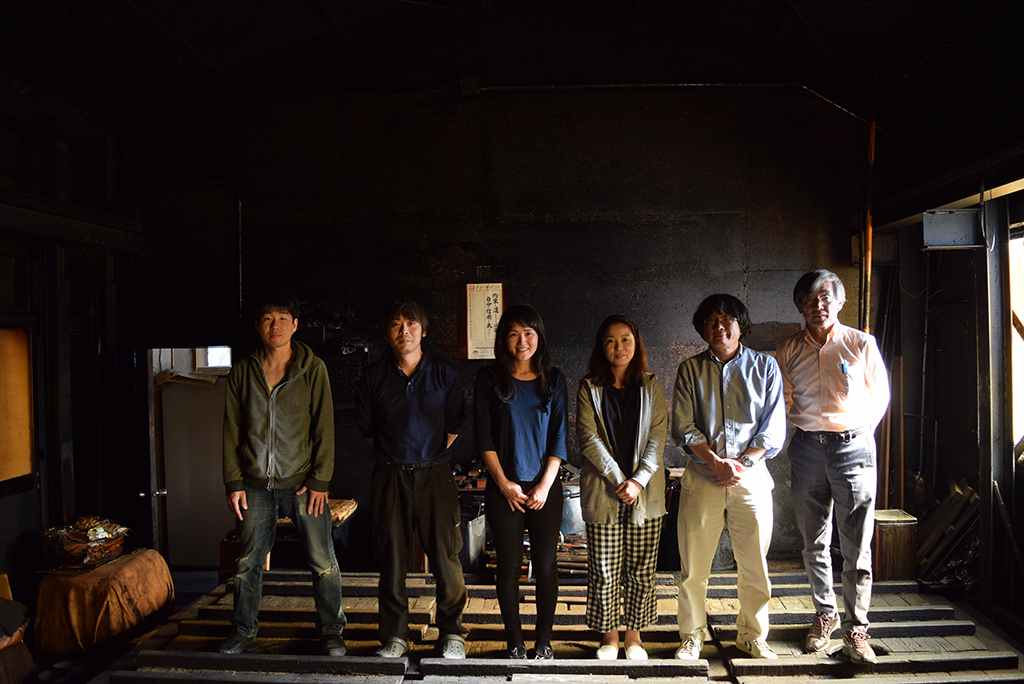
The three are good friends. From left, President Yoshiki, Mr. Kurosaki, and Business Division Manager Tomofumi
President Kumagai : "I think it would have been really hard for Kurosaki to do it all by himself. If he spent more time on sales, he would have less time for production, and if he was producing, he wouldn't be able to do sales. So we decided to have him come to Sendai, but to do it as a company." —Did you not have a physical store here at the time? Tomofumi: "Not at all. I also helped out at a restaurant." How was it advertised at the time? President Kumagai : "We advertised our products by having kendo practitioners who came to restaurants in Sendai buy samples. We wanted to make this into a full-scale business, so we persuaded Kurosaki." —Mr. Kurosaki, you have no connection to Sendai, right? Kurosaki : "Nothing. But I thought I'd like to work with you." President Kumagai : "In the end, they said they would do it, so I rented a space that could be used as a workshop and a small studio."Why did you choose to create an apparel brand specializing in Kendo?
 — "If the only thing we're talking about is doing 'clothing' and 'living' at work, there's no need for it to be kendo."
Tomofumi : "That would be my gratitude for kendo. By the way, I also have a similar understanding of 'living', and I think of items, spaces, music, etc. that make life richer and happier. For example, I think of drinking coffee with music as 'living'."
President Kumagai : "The things I want to do, the things I can do, and the things I have to do all came together through the 'enn living works' project. Meeting Kurosaki was also a big factor."
— "If the only thing we're talking about is doing 'clothing' and 'living' at work, there's no need for it to be kendo."
Tomofumi : "That would be my gratitude for kendo. By the way, I also have a similar understanding of 'living', and I think of items, spaces, music, etc. that make life richer and happier. For example, I think of drinking coffee with music as 'living'."
President Kumagai : "The things I want to do, the things I can do, and the things I have to do all came together through the 'enn living works' project. Meeting Kurosaki was also a big factor."

Kurosaki craftsman working on a sewing machine with complete concentration
-I think there are many products that use sashiko. Did you choose this material because you wanted to contribute to "clothing" and "living" by utilizing traditional Japanese techniques? Tomofumi: "Initially, I mainly wanted to make things out of used judo uniforms. If I could turn my judo uniforms, which are filled with memories, into bags, they would be reborn as a part of my everyday life." -It would also make a good gift. Tomofumi: "I thought that for students, it would be a great gift to give their parents a bag that has been imbued with their sweat and passion when they graduate."Kibidango, the turning point

Crowdfunding service "kibidango"
—Could you tell us about the difficulties you faced in commercializing the product, as described in kibidango (the name of the crowdfunding service that enn used to raise ¥1,191,247)? President Kumagai : "We didn't have the funds to start. It was something that not many people were doing, and the image of used kendo uniforms was that they were smelly and dirty. We had a hard time raising funds." -The significance of fundraising is significant. President Kumagai : "Even if we wanted to use new sashiko, it's difficult to produce large quantities because it's a special fabric. The factory won't even make one or two pieces, so even if we brought in the fabric and had it made in large quantities, it would cost quite a bit of money." —How long did you collect funds through crowdfunding? President Kumagai : "It took a month. Thankfully, we managed to raise nearly 1.2 million yen." --That's amazing. When did you achieve your goal? President Kumagai : "It was the very last minute. I was worried, this isn't going to work out. When I asked the service operators, they said that everyone was investing at the very last minute." -I see, that's true. President Kumagai : "I thought it would be bad if we were at the very limit, but once it reached 80-90%, it went up all at once and it turned out fine." -Do you want to spread the culture of sashiko to people other than those who practice kendo? President Kumagai : "I would be happy if people who are unfamiliar with sashiko think, 'That's nice, I didn't know there was a fabric like this,' or 'So this is what happens when you remake kendo uniform fabric.'" What was good about achieving your goal? President Kumagai : "We were able to secure the fabric and the factory line. We were able to place an order, and that's how our relationship began. Because of that relationship of trust, we can continue to do business together." Tomofumi: "Factory and fabric stores will only follow the manual if they don't have a track record. They won't be able to take all the details into consideration until you take the first step of placing an order." First of all, we were able to build a relationship of trust. Kurosaki : "It's a relationship of trust that leads to continued orders (laughs)." President Kumagai : "It seems like we can't do such a small lot of work for someone we don't know. Kibidango's crowdfunding was a great first step." - Are there any difficulties or challenges you've faced when raising funds through crowdfunding? President Kumagai : "Because Kurosaki makes everything by himself, he can grasp the entire process of cutting, sewing, and pattern making. Each piece takes time, but if it's something like this, it can be completed in two days, and he can grasp how it will be completed on the spot." -So it's difficult to keep track of what is produced in a factory. President Kumagai : "Communication is important in factories, and sometimes the finished product is slightly different from what we imagined. I learned that close communication is even more important." -Currently, your sales channels are physical stores and an online store. Are there any difficulties in terms of sales? Tomofumi: "It's been difficult, but thanks to the fundraising we've been able to get things in order. We're also stepping up our participation in kendo tournaments."
Representative of "Ichijin" Iwasaki, who is a sales agent for enn living works
Iwasaki : "When we set up a stall at the National Sports Festival, all the T-shirts we brought with us sold out. Kids' items were especially popular, so maybe there's a demand for them in that area. Our products have an American feel, so they're eye-catching."Exploring the strengths of the brand
 President Kumagai : "When it comes to the products Kurosaki makes, we make them using the judo uniforms that we have been entrusted with. There are no other companies doing this, so it's a product whose value is easy to understand. On the other hand, if we make accessories in a factory, even though we put a lot of thought into them, the value that is conveyed to the user is diminished."
-That does seem like a dilemma.
President Kumagai : "We've said that in the future, if we don't take it overseas, it won't sell. Since it's a Japanese brand that sells overseas, it would be ideal to re-import it."
—Even among people who practice kendo, there are still many who don't know about your company.
President Kumagai : "It's only been a year since we started. Not many people know about it."
—I think there are a lot of people who would want it if they knew about it.
Tomofumi : "Our strength is that Kurosaki actually operates the sewing machine. I don't think there is any other company in Japan that offers a service that allows you to have your own custom-made judo uniform delivered to you on a fairly consistent basis."
—That makes it hard to imitate.
President Kumagai : "That is our starting point and ultimate strength."
Tomofumi: "Although this product is not made by Kurosaki, I think it will be good if the fact that it is made by enn adds value."
—You could also consider branding your business as "Kurosaki's enn living works," putting Kurosaki at the forefront.
President Kumagai : "When it comes to the products Kurosaki makes, we make them using the judo uniforms that we have been entrusted with. There are no other companies doing this, so it's a product whose value is easy to understand. On the other hand, if we make accessories in a factory, even though we put a lot of thought into them, the value that is conveyed to the user is diminished."
-That does seem like a dilemma.
President Kumagai : "We've said that in the future, if we don't take it overseas, it won't sell. Since it's a Japanese brand that sells overseas, it would be ideal to re-import it."
—Even among people who practice kendo, there are still many who don't know about your company.
President Kumagai : "It's only been a year since we started. Not many people know about it."
—I think there are a lot of people who would want it if they knew about it.
Tomofumi : "Our strength is that Kurosaki actually operates the sewing machine. I don't think there is any other company in Japan that offers a service that allows you to have your own custom-made judo uniform delivered to you on a fairly consistent basis."
—That makes it hard to imitate.
President Kumagai : "That is our starting point and ultimate strength."
Tomofumi: "Although this product is not made by Kurosaki, I think it will be good if the fact that it is made by enn adds value."
—You could also consider branding your business as "Kurosaki's enn living works," putting Kurosaki at the forefront.
I want to create a sashiko boom through re-importation
President Kumagai : "I think it's really cool that fashionable college students come to a protective gear store to buy our bags." --If you are placed in such a position, it seems likely that the negative image of kendo as being smelly and dirty will improve. Tomofumi: "In the end, it would be ideal if kendo spread throughout the world when people started thinking that the enn living works bags were cool. When we take them overseas, I want people to know that it's kendo when they say, 'Japanese Sashiko Aizome?' and that Japanese kendo will become more widely known. I may not be able to carry out specific promotional activities to increase the number of kendo practitioners, but I would like to contribute to the spread of kendo from a different angle." —That's a unique way for your company to contribute to kendo. Thank you for your time today. Click here to see the product page of enn living works, who was interviewed this time!
interviewer
◎Bushizo Co., Ltd. Representative Director: Go Uejima
Click here to see the product page of enn living works, who was interviewed this time!
interviewer
◎Bushizo Co., Ltd. Representative Director: Go Uejima
 Born in Sendai in 1987. While in the Sendai High School Kendo Club, he studied under Mitsunobu Sato and made it to the top eight of the Inter-High School Championships.
After graduating from university, he worked as the business development manager for a restaurant chain with 200 stores across the U.S. He worked in sales at a foreign internet advertising company and as the head of the sales department and president's office at Innova Co., Ltd., before founding Bushizo Inc. in January 2017.
◎Bushizo Co., Ltd. Director Yusuke Kudo
Born in Sendai in 1987. While in the Sendai High School Kendo Club, he studied under Mitsunobu Sato and made it to the top eight of the Inter-High School Championships.
After graduating from university, he worked as the business development manager for a restaurant chain with 200 stores across the U.S. He worked in sales at a foreign internet advertising company and as the head of the sales department and president's office at Innova Co., Ltd., before founding Bushizo Inc. in January 2017.
◎Bushizo Co., Ltd. Director Yusuke Kudo
 Born in Hokkaido in 1984. Graduated from Rikkyo University's Faculty of Law. While in school, he launched a free magazine and provided marketing support for an apparel brand. In 2008, he joined Yahoo Japan Corporation, where he worked in sales of advertising products such as search advertising and display advertising. In January 2017, he founded Bushizo Inc. He began practicing kendo at the age of six and continues to practice it to this day.