Armor Set
 面
面
 Kote
Kote
 胴
胴
 垂
垂
 Dogi
Dogi
 袴
袴
 bamboo sword
 wooden sword
 armor bag
 Bamboo sword bag
 Small items
 gift
gift
 Books/DVDs
 cleaning
 Armor repair
 Kendo mask
 Iaido
Iaido
 Japanese swords and art swords
 Mitsuboshi
 Tozando
 Matsukan
 Japan Kendo Equipment Factory
 West Japan Martial Arts Equipment
 Glory Martial Arts Equipment
 Nobutake
 Busougi
 Hakataya
 Shokodo
 Flag Ito
 メールお問い合わせ
 LINEお問い合わせ


 Value Set
 Armor Set
 面
面
 Kote
Kote
 胴
胴
 垂
垂
 Dogi
Dogi
 袴
袴
 bamboo sword
 wooden sword
 armor bag
 Bamboo sword bag
 Small items
 gift
gift
 Books/DVDs
 cleaning
 Armor repair
 Kendo mask
 Outlet
 Iaido
Iaido
 Japanese swords and art swords
 Mitsuboshi
 Tozando
 Matsukan
 Japan Kendo Equipment Factory
 West Japan Martial Arts Equipment
 Glory Martial Arts Equipment
 Nobutake
 Taiyo Industry
 Busougi
 Hakataya
 Shokodo
 Flag Ito
 Interviews Useful Articles
 Size Measurement Guide
 User Guide
 GLOBAL SHIPPING GUIDANCE
 Frequently Asked Questions Q&A
 Company Profile

Overview of this article
On March 29, 2019, the All Japan Kendo Federation announced on its official website " Revisions to Kendo Match and Refereeing Rules ."
The purpose of this notice is to inform you of some changes to the rules regarding shinai and kendo equipment. Please make sure you understand the contents of this notice so that you can smoothly select your kendo equipment. It is not widely known, but many shinai products on the market are "non-compliant." Therefore, care must be taken when selecting a shinai.
The key points are rule changes and precautions regarding the equipment used in official matches.
Since this is a rule for "official matches," it is not mentioned in regular training. I would like you to organize and understand this information.
In this article, we would like to supplement the information released by the All Japan Kendo Federation to make the content easier to understand, so we will refrain from expressing subjective opinions as much as possible.
Revisions regarding bamboo swords
The following are the latest rules for Shinai. The parts in red are the newly added and revised parts.
It mentions that the overall shape and shape processing (=cutting) have been clearly defined, and that standards for measuring the tip of the ``chikutou'' have been established.
In official tournaments, the bamboo swords will be weighed in based on these rules.
Changes
Article 2 of the Bylaws and Article 3 of the Rules (Bamboo Swords) are as follows:
-
The structure of the shinai must be split into four pieces, and no foreign objects (other than the core inside the tip leather or pieces of the handle) may be placed inside. Shinai with large gaps between the pieces (split bamboo), or those with processing or shape changes that significantly impair safety, may not be used . The names of each part are as shown in Figure 2.
-
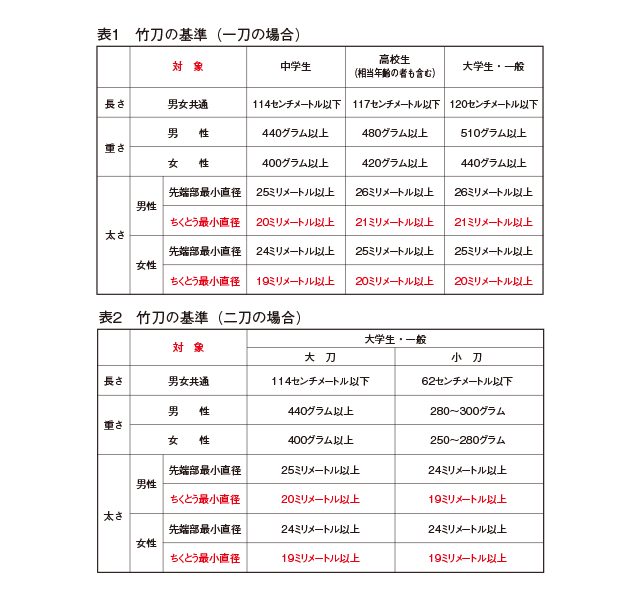
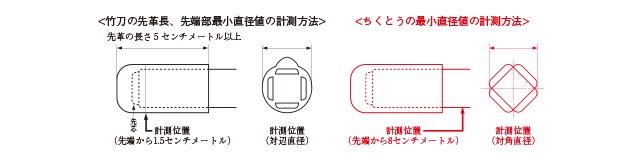
The standards for shinai are as shown in Tables 1 and 2. However, the length is the total length including any accessories, and the weight does not include the tsuba (guard). The thickness is determined by the smallest diameter (flat diameter) at the tip of the sakikawa (leather) and the diameter of the tsuba (smallest diameter diagonally at 8.0 cm from the tip of the shinai). The tip of the shinai is the thinnest part of the tsuba, and the tsuba becomes thicker from the tip towards the monouchi.
(Quoted from Article 2 of the All Japan Kendo Federation's Kendo Match and Refereeing Rules)
*Chikutou: refers to the four pieces of bamboo that are joined together by means of a chigiri (metal piece that joins the bamboo together). This refers to the so-called "bamboo only" without any accessories.
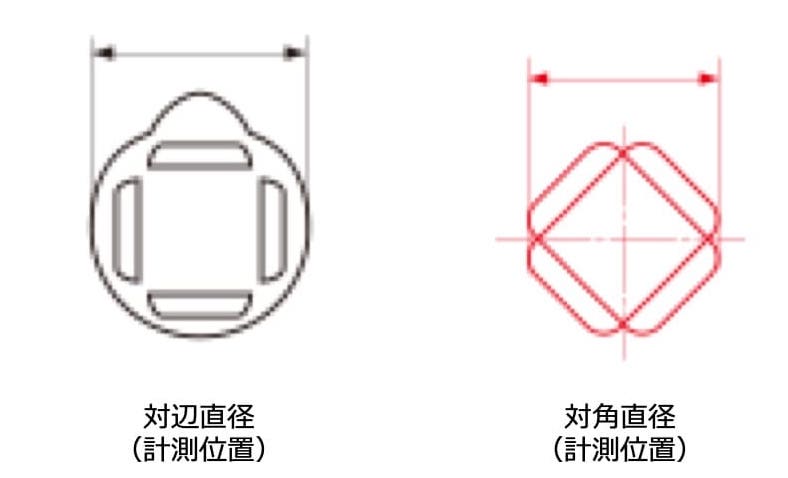
*Opposite side diameter: The diameter of the four sides of a bamboo sword when put together.
*Diagonal diameter: The diameter between the diagonals of the four pieces of the bamboo sword when put together.
<Face diameter and diagonal diameter>
History of the revision of the regulations
According to a committee statement issued by the All Japan Kendo Federation Special Subcommittee on the Safety of Bamboo Swords and Kendo Equipment regarding the revision of match refereeing rules for kendo equipment ,
"This case stems from the recent increase in cases of bamboo sword modifications, where the bamboo sword is significantly thinner from the tip to the striking part , with the aim of making it easier to use in matches and making it feel lighter ."
"These modifications make the shinai more likely to break and increase the danger of kendo, and the All Japan Kendo Federation could not overlook them. Furthermore, they go against the principles of the sword and raise serious issues not only about safety but also about the fairness of matches."
It says:
Furthermore, in the conventional method of measuring only the tip, even if the tip of the shinai is made excessively thin, the thickness of the tip can be adjusted by the thickness of the leather tip , so we have decided to also measure the diagonal diameter of the tip (the part 8 cm from the tip that is not covered by the leather tip) .
Furthermore, "Is it enough if the part 8cm from the tip meets the regulations? What about the part 7.5cm or 8.5cm?
In response to public comments such as, "Is it okay to make it thinner?", it was decided to clarify that " the tip shall be the thinnest part of the needle, and the needle shall become thicker from the tip towards the handle," and that the measurement shall be determined visually.
There was also a point made that "there are loopholes, such as widening only the sides of the bamboo and reducing the thickness of the back," but the response to this was limited to "trusting the user's common sense regarding safety."
Examples of illegal bamboo swords
Here are some examples of bamboo swords that may have met the previous regulations but would be considered illegal under the revised regulations.
- A foreign object (clay or weight) is placed in the hand to make the tip relatively lighter

- Pieces (quartered bamboo) with large gaps between them

・Shinai that are thinly shaved and have a large tip that meets the regulations.

・The tip is thinner than the tip

Things to note when purchasing a bamboo sword
Although there is no comprehensive statistical data, the bamboo swords that are widely available, not just at specific shops such as BUSHIZO or other martial arts equipment stores, are not made in accordance with these regulations.
Shinai are mainly produced in factories in Indonesia and China and shipped to Japan, but the current situation is that these regulations do not extend to the production areas of Japanese manufacturers and factories.
Shinai come in a variety of shapes. Furthermore, there are individual differences, so even if the product is the same, it may not meet the regulations. Therefore, when purchasing, you must clearly tell the seller that you are looking for a shinai that meets the regulations.

★How to order a Shinai that complies with the "new regulations" from BUSHIZO
Before completing your order, there is a free-form field called "Other inquiries" on the page.
Please write a note saying , "Please make sure it meets the standards of the new regulations."

*This may be difficult depending on the product, but we expect to be able to accommodate in most cases.
Click here to purchase BUSHIZO bamboo swords

Future Plans
Currently, popular bamboo sword products are not manufactured in accordance with the new regulations, and some people find it difficult to use when holding and swinging a bamboo sword that complies with the new regulations, even if it is a product of the same brand, due to the balance of the center of gravity.
In the future, it is likely that industry groups and manufacturers will move in line with the wishes of the All Japan Kendo Federation, so I think it will become easier to choose a bamboo sword than it is now.